No products in the cart.

Need help? Call us:
+966 59 204 1946
Shopping cart (0)
Subtotal: 0.00 ر.س
Spend 2,500.00 ر.س to get free shipping
Congratulations! You've got free shipping.
ASKA SOLUTION
Online Industrial Hardware Store
One stop online Industrial Hardware store is your ultimate destination for all your industrial needs in KSA. We offer a comprehensive range of high-quality hardware products, from nuts and bolts to specialized tools.
Save upto 15% discount on
Tools & Hardware for FabricationPlumbingSecurityPaintingHVACElectricalPlumbingElectronicsMechanical Operations
Aska Solution is the most trusted laboratory glass vials supplier in Saudi Arabia, delivering certified, high-precision containment solutions to analytical laboratories, petrochemical complexes, pharmaceutical manufacturers, and scientific research facilities across the Kingdom. In precision analytical testing and scientific research, sample integrity is non-negotiable. We supply a comprehensive inventory of ASTM and USP-compliant Laboratory Glass Vials, engineered for exceptional chemical resistance, structural uniformity, and zero sample loss. Whether your operations require high-throughput auto sampler vial units in Jubail, amber pharmaceutical glass vials in Riyadh, or wholesale glass vials in Dammam, Aska Solution bridges global manufacturing quality with dependable local supply. With extensive warehouse stock held locally in the Eastern Province, we help laboratories eliminate downtime, satisfy international analytical standards, and protect their critical data.
The Role of Laboratory Glass Vials in Modern Scientific & Industrial Workflows
In analytical chemistry, environmental testing, and material characterization, the sample container is never just an inert container—it is a critical control variable. A laboratory glass vial serves as the primary barrier protecting sensitive compounds from atmospheric moisture, oxidative degradation, and chemical volatilization. Across Saudi Arabia's industrial corridors—from downstream petrochemical complexes in Jubail and Yanbu to pharmaceutical quality control labs and university research centers in Riyadh—laboratories work with volatile, reactive, and trace-level analytes every single day.When a sample vial leaches sodium ions into an aqueous solution, absorbs polar target molecules onto untreated wall surfaces, or fails to maintain a hermetic seal under high ambient temperatures, analytical sequences fail. The resulting baseline drift, ghost peaks, and instrument downtime cost facilities significant time and financial resources. Sourcing premium laboratory glassware from a dedicated glass vial supplier ensures that every injection into an HPLC, GC, or mass spectrometer yields reliable, audit-ready data. At Aska Solution, our vials are specifically selected to withstand the operational stresses of Saudi Arabian laboratories, from high-temperature headspace incubation to sub-zero cold-chain sample storage.Anatomy & Terminology: Understanding Scientific Glass Vials
Selecting the correct vial requires an understanding of its dimensional geometry, thread profile, and closure system. Matching these physical parameters prevents autosampler gripper errors, needle bending, and sample evaporation.Neck Finishes and Thread Profiles
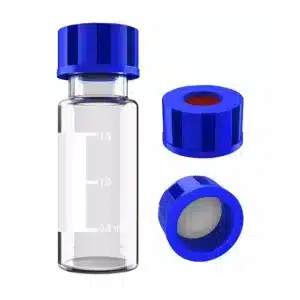
- Screw Thread Finishes (GPI Standard): Designated by standard sizing such as 8-425, 9-425, 13-425, and 24-400. The first number indicates the outer thread diameter in millimeters, while the second denotes the specific thread depth and pitch. Screw top vials provide dependable, resealable torque compression for routine sample storage and automated sampling.
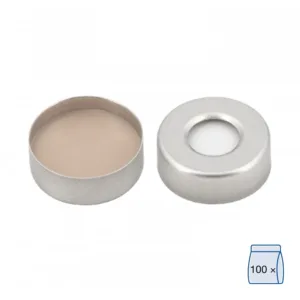
- Crimp Top Finishes: Standardized primarily in 11mm and 20mm outer neck diameters. Designed for aluminum seals crimped tightly with manual or pneumatic crimpers, crimp necks deliver the most hermetic seal for volatile organic compounds and high-temperature headspace testing.
- Snap Ring / Snap Top Finishes: Feature a specialized collar that accepts push-on polyethylene snap caps. This configuration eliminates the need for crimping tools while reducing technician fatigue during high-volume sample preparation.
Dimensional Geometry & Tolerances
Chromatography vials are universally categorized by Outer Diameter (OD) × Overall Height (OAL) in millimeters. The 12×32mm profile represents the worldwide standard for 2mL chromatography carousels. Uniform wall thickness is crucial: inconsistent walls cause optical refraction variations in automated liquid handlers and introduce thermal stress concentrations during rapid heating or cooling cycles.Base Configurations and Sample Recovery
- Flat Base: The universal standard, providing maximum stability on flat laboratory benches, heating blocks, and autosampler trays.
- Conical & V-Bottom Vials: Engineered with a tapered internal cone inside a flat exterior foot. This geometry concentrates micro-volume samples (down to 5 µL) directly beneath the autosampler needle, eliminating dead volume in low-yield chemical synthesis or forensic extractions.
- High-Recovery Solid Bases: Built with a smooth, concave internal reservoir that maximizes sample recovery without requiring separate, fragile micro-inserts.
Septa Chemistry and Closure Systems
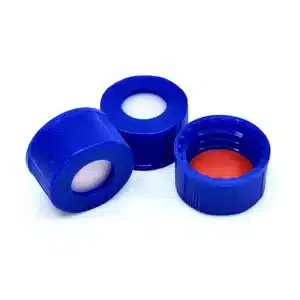
A vial's reliability depends directly on its closure. Closures combine an outer polypropylene or aluminum ring with an elastomeric septum:- PTFE/Silicone: The gold standard for analytical chromatography. Chemically inert PTFE faces the sample matrix, while high-elasticity silicone provides an effective reseal around the injection needle.
- Pre-Slit Septa: Feature a factory laser-cut slit that prevents internal vacuum buildup and thin-gauge needle deflection during rapid autosampler aspiration.
- Bonded Closures: The septum is molecularly bonded to the cap rim, preventing liner push-through or slippage during robotic needle puncture.
Strength & Durability Factors
Industrial testing environments subject sample containers to severe mechanical, hydrodynamic, and thermal stresses. Understanding these performance boundaries prevents laboratory accidents and equipment damage.Internal Vapor Pressure Resistance
In static headspace gas chromatography, samples are heated up to 150°C to volatilize light organic compounds into the gas phase. This process generates substantial internal vapor pressure. High-grade headspace vials feature thicker walls and bevelled crimp finishes rated to withstand working pressures up to 3 to 5 bar (45 to 75 psi). Safety release caps are calibrated to unseat and vent safely before the glass reaches its burst threshold.Robotic Needle Impact and Concentricity
Modern autosamplers utilize steel needles that strike the vial closure at high vertical velocity. If a vial lacks rotational concentricity, the needle strikes off-center, causing bent needles, instrument aborts, or rubber coring into the sample. Precision-manufactured glass sample vials maintain tight concentric alignment tolerances (±0.2mm) across thousands of continuous cycles.Resistance to Thermal Shock
Laboratory workflows frequently demand rapid transitions between thermal extremes, such as moving frozen biological standards from a -80°C ultra-low freezer into a warm water bath, or running dry-heat depyrogenation cycles at 250°C. Quality borosilicate glass safely endures sudden temperature differentials exceeding 100°C without micro-cracking.Safety Factors & Chemical Containment
Sample containment directly impacts analytical accuracy and laboratory safety. When handling hazardous petrochemical distillates, volatile solvents, or toxic bio-reagents, reliable containment is your primary safeguard.| Containment Factor | Underlying Risk | Protective Engineering in Quality Vials |
|---|---|---|
| Volatile Evaporation | Vapor escape causing sample concentration shift | Continuous sealing ridges and virgin PTFE/Silicone tight seal |
| Alkali Leaching | pH shifts and sodium/boron contamination in mobile phases | Type I neutral borosilicate glass composition (ISO 719 Class 1) |
| Analyte Adsorption | Polar compounds binding to reactive inner walls | Gas-phase silanized / deactivated internal surfaces |
| Septum Coring | Rubber fragments clogging HPLC valves and columns | High-elasticity medical silicone with pre-slit options |
| Thermal Shock | Vessel shattering during temperature cycling | Low-expansion borosilicate chemistry (3.3 × 10⁻⁶/K) |
Preventing Volatile Evaporation
Solvents like hexane, methanol, and dichloromethane possess high vapor pressures. In the elevated ambient temperatures common in the Middle East, standard containers risk evaporative losses that alter analyte concentrations. Our glass vials with caps feature engineered compression beads that distribute downward force evenly across the vial rim, preventing evaporative loss through extended sample storage intervals.Minimizing Extractables and Leachables (E&L)
In LC-MS, GC-MS, and trace ICP-MS testing, low-grade glass can leach sodium, boron, arsenic, and trace metals into aqueous solutions. This produces unwanted ghost peaks, elevates baseline noise, and obscures target analytes. Using Type I borosilicate glassware ensures the lowest possible extractable profile, preserving the validity of your regulatory testing.Types of Industrial & Scientific Vials
Aska Solution supplies an extensive range of precision-manufactured vials tailored to specific analytical methods, instruments, and testing protocols:1. Auto Sampler Vials (Chromatography)
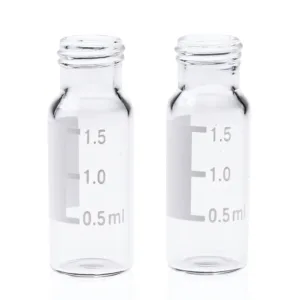
Engineered for seamless compatibility with leading chromatography platforms, including Agilent, Waters, Shimadzu, and Thermo Fisher. The standard 2mL (12×32mm) auto sampler vial is available in 9-425 screw neck, 11mm crimp neck, and 11mm snap ring formats. Ceramic writing patches and graduation marks allow quick sample identification and volume verification.2. Glass Scintillation Vials
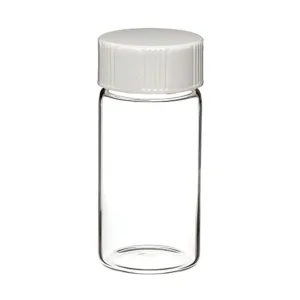
Engineered for liquid scintillation counting (LSC), environmental radiation monitoring, and radioactive tracer assays. Our glass scintillation vials are manufactured from low-potassium borosilicate glass. Eliminating Potassium-40 (40K) minimizes background radiation counts, ensuring high counting efficiency in sensitive radiometric testing.3. Pharmaceutical Glass Vials
Built to satisfy strict pharmacopeial monographs for parenteral medications, vaccines, and active compounds. Available in tubular and molded finishes with 13mm and 20mm crimp necks, these pharmaceutical glass vials accommodate lyophilization (freeze-drying) stoppers and aluminum tear-off or flip-off safety seals.4. Headspace Vials
Engineered with heavy-wall borosilicate construction and rounded or flat bases to handle internal vapor pressures during thermal extraction. Available in 10mL and 20mL volumes (22.5×46mm and 22.5×75mm) with bevelled crimp or precision screw finishes.5. Screw Top Vials & Sample Storage Vials
Ranging from 1.5mL to 60mL, these general-purpose glass sample vials serve as dependable workhorses for petrochemical core archives, chemical synthesis, and reference retention. Supplied with chemical-resistant PTFE-lined phenolic or polypropylene caps to resist aromatic hydrocarbons and aggressive reagents.6. EPA / VOA Vials (Environmental Testing)
Cleaned and certified according to EPA 40 CFR Part 136 guidelines for Volatile Organic Analysis (VOA). Standardized in 20mL, 40mL, and 60mL formats with 24-400 screw threads and open-top caps fitted with 0.125-inch PTFE/silicone septa, each lot is certified clean of trace organics.Materials Used in Laboratory Glass Vials
Understanding the chemical composition of glass ensures compatibility with analytical compounds, thermal stresses, and pH extremes.1. Type I Borosilicate Glass (Clear and Amber)
Type I glass is a premium, neutral glass with superior hydrolytic resistance:- Borosilicate 3.3 Glass: The purest laboratory glass formulation. Composed of approximately 81% silica (SiO2) and 13% boric oxide (B2O3), it provides a very low thermal expansion coefficient (3.3 × 10⁻⁶/K), exceptional resistance to thermal shock, and minimal chemical leaching.
- Borosilicate 5.1 Glass: Also classified as Type I glass, offering dependable chemical stability and mechanical strength for pharmaceutical packaging and chromatography.
- Amber Borosilicate: Infused with iron oxides during manufacturing, amber glass blocks actinic light between 200 nm and 500 nm. This provides vital protection for photosensitive compounds, including vitamins, active pharmaceutical ingredients (APIs), and light-sensitive petroleum fractions.
2. Type III Soda-Lime Glass
Composed primarily of silica, soda, and lime. While economical for non-critical applications, soda-lime glass possesses moderate chemical resistance and can release sodium ions into neutral or acidic aqueous solutions over time. It is best suited for dry powders, non-aqueous chemicals, and ambient solid storage.3. Deactivated / Silanized Glass
For ultra-trace chromatography where polar molecules (such as proteins, peptides, pesticides, or alkaloids) tend to bind to active silanol (Si-OH) groups on the glass surface. Silanized vials undergo gas-phase organosilane treatment, creating an inert, hydrophobic barrier that prevents sample adsorption and maximizes analytical recovery.Comparison Section: Laboratory Glass Vial Types & Specifications
To assist laboratory directors and procurement specialists in selecting the optimal configuration, the following table details the technical specifications of our primary scientific glass vials:| Vial Category | Standard Volume | Neck Finish Style | Glass Composition | Primary Industry Application | Key Performance Feature |
|---|---|---|---|---|---|
| Standard Autosampler Vial | 1.5 mL – 2.0 mL | 9-425 Screw / 11mm Crimp | Type I Borosilicate (Clear / Amber) | HPLC, UHPLC, GC, GC-MS routine screening | Universal fit across major robotic carousels |
| Headspace Vial | 10 mL / 20 mL | 20mm Crimp / 18mm Precision Screw | Heavy-Wall Type I Borosilicate | Petrochemical residuals, water volatiles, blood alcohol | Withstands internal working pressures up to 5 bar |
| Scintillation Vial | 7 mL / 20 mL | 22-400 / 24-400 Screw | Low-Potassium Borosilicate 3.3 | Liquid scintillation counting (LSC), radiometric assays | Ultra-low background radiation count (40K) |
| EPA / VOA Vial | 20 mL, 40 mL, 60 mL | 24-400 Screw Neck | Type I Borosilicate (Clear / Amber) | Municipal water, environmental effluents, soil VOCs | Lot-certified zero TOC and volatile contaminants |
| Pharmaceutical Lyophilization | 2 mL – 100 mL | 13mm / 20mm Crimp Neck | Type I Borosilicate USP <660> | Freeze-drying, sterile parenterals, vaccine packaging | Flat, uniform base for optimal freeze-drier heat transfer |
| High-Recovery Micro Vial | 0.3 mL – 1.1 mL | 9-425 Screw Neck | Type I Borosilicate with Conical Interior | Trace synthesis, forensics, micro-metabolomics | Reduces residual sample dead volume to <5 µL |
| General Sample Storage Vial | 4 mL – 60 mL | Continuous Thread (GPI) | Type I or Type III Glass | Core sample archiving, petrochemical standards | Broad volume capacity with chemical-resistant caps |
Protective Features of High-Grade Glass Vials
Modern scientific glass vials incorporate several critical design features to safeguard analytical workflows and ensure laboratory safety:- Controlled Annealing for Stress Relief: Every vial passes through a precision annealing lehr during production to eliminate internal mechanical stresses, preventing spontaneous shattering during heating or high-speed centrifugation.
- Resilient Septum Memory: Cap liners use high-purity medical-grade silicone that reseals cleanly after repeated needle punctures, preventing solvent evaporation during long overnight autosampler queues.
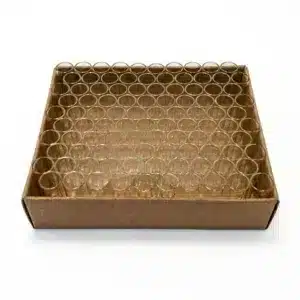
- Cleanroom Production & Packaging: Vials and closures are manufactured and packed in Class 100,000 cleanrooms and sealed in heavy-duty shrink-wrapped trays to prevent particulate contamination before use.
- Consistent Thread Geometry: Automated optoelectronic inspection ensures thread pitches match cap dimensions perfectly, preventing cross-threading and maintaining an even seal every time.
Standards and Quality Certifications
In regulated testing environments, compliance documentation is essential. Aska Solution supplies laboratory glass vials that satisfy rigorous international quality standards:- Pharmacopeial Compliance (USP, EP, JP): Our pharmaceutical and chromatography glass vials meet United States Pharmacopeia (USP <660>), European Pharmacopoeia (EP 3.2.1), and Japanese Pharmacopoeia (JP) criteria for Type I neutral glass.
- ASTM International Standards: Conforming to ASTM E438 Class A and Class B specifications, ensuring verified glass purity, high chemical durability, and strict linear expansion limits.
- ISO Quality Frameworks: Produced in manufacturing facilities operating under ISO 9001:2015 quality management and ISO 15378 standards for primary packaging materials of medicinal products.
- Traceable Certificates of Analysis (CoA): Every production batch is backed by lot-traceable test certificates covering dimensional checks, chemical leaching tests, and particulate cleanliness scores to support your ISO 17025 laboratory audits.
How to Choose the Right Glass Vial: A Step-by-Step Technical Guide
Use this four-step technical guide to select the ideal vial configuration for your laboratory requirements:- Step 1: Confirm Instrument and Tray Compatibility: Match your autosampler tray specifications. While 9-425 screw vials provide broad compatibility across modern Agilent, Shimadzu, and Thermo Fisher carousels, certain high-temperature systems or robotic grippers require 11mm crimp neck vials.
- Step 2: Determine Analyte Light Sensitivity: If working with vitamins, light-sensitive hydrocarbons, or aromatic compounds that degrade under ambient light, choose amber borosilicate glass. For general solvents and clear optical inspection, select clear Type I glass.
- Step 3: Check Thermal and Pressure Demands: For static headspace incubation above 100°C, always use heavy-wall, pressure-rated headspace vials with safety release closures. For routine room-temperature or refrigerated chromatography, standard 2mL vials are ideal.
- Step 4: Select Closure and Septum Style: For single-injection runs, standard PTFE/red rubber septa offer an economical solution. For sensitive LC-MS analysis, trace environmental testing, or multi-injection sequences, choose premium bonded PTFE/silicone or pre-slit closures to prevent vacuum formation and coring.
Applications Across Industries in Saudi Arabia
Laboratories throughout the Kingdom rely on consistent glass consumables to support quality testing and research programs:Petrochemical Refining & Gas Processing (Aramco, SABIC, Sadara)
Refining and downstream chemical operations in Jubail, Yanbu, and Ras Tanura run continuous quality control testing on crude oils, fuels, polymers, and specialty chemicals. Our amber glass sample vials and headspace systems resist aggressive hydrocarbon matrices like benzene, xylene, and naphtha without swelling or degrading cap seals.Environmental Analysis & Desalination Facilities (SWCC, NCEC)
With extensive marine preservation monitoring along the Arabian Gulf and Red Sea, environmental testing laboratories rely on certified 40mL EPA/VOA vials to detect trace volatile organics, pesticides, and industrial discharge with zero background contamination.Pharmaceutical & Diagnostic Laboratories
Domestic pharmaceutical manufacturers in Riyadh, Jeddah, and Dammam utilize sterile pharmaceutical glass vials for stability chambers, injectable batch testing, and vaccine distribution, backed by comprehensive USP <660> compliance documentation.Academic & Research Institutions (KAUST, KFUPM, KSU)
Universities and scientific research centers rely on borosilicate glass scintillation vials, micro-inserts, and silanized surface vials for cutting-edge work in nanomedicine, isotopic dating, and catalytic research.Precautions and Best Practices for Handling Glass Vials
Observing proper handling and storage practices preserves sample integrity and ensures operator safety:- Inspect Vials Before Use: Check vials for small rim chips, hairline fractures, or packaging dust, especially when running high-pressure headspace sequences where structural defects can lead to breakage.
- Avoid Over-Tightening Caps: Over-tightening screw caps can cause the septum to cup or warp inwards, creating leak channels and increasing the risk of needle deflection. Hand-tighten until snug, or use torque-controlled caps.
- Calibrate Crimping Tools: When using aluminum seals, verify that crimpers are properly adjusted. A loose cap can spin freely, allowing solvent vapor to escape, while an over-crimped cap pinches the septum and compromises the seal.
- Leave Caps Loose During Autoclaving: When autoclaving glass vials, keep screw caps loose to allow internal pressure to equalize, preventing glass breakage during depressurization cycles.
- Store Vials Away from Solvents: Store unused vials and cap trays in clean, dry cabinets away from volatile solvent storage. Elastomeric septa can absorb ambient organic vapors over time, introducing contamination into future blanks.
Our Kingdom-Wide Service and Supply Network
Consistent industrial testing requires a reliable domestic supply chain. Aska Solution provides dependable local stock reserves across Saudi Arabia, helping laboratories avoid lengthy international lead times.Strategic Logistics Hub in Dammam
Situated in the Eastern Province, our central warehouse in Dammam provides quick logistical access to the Kingdom's largest petrochemical and industrial centers. Holding substantial local inventory allows us to fulfill orders rapidly and help facilities maintain smooth testing operations.Comprehensive Kingdom-Wide Coverage
- Eastern Province: Fast scheduled delivery to Dammam 1st, 2nd, and 3rd Industrial Cities, Jubail Industrial City, Khobar, Dhahran, and Ras Al Khair.
- Central Province: Daily dispatches to Riyadh industrial zones, healthcare testing facilities, and academic research institutions.
- Western Province: Reliable fulfillment to Jeddah, Yanbu Industrial City, Rabigh, and King Abdullah Economic City (KAEC).
Why Choose Aska Solution for Glass Vials in Saudi Arabia?
Partnering with Aska Solution gives your laboratory access to top-tier products, local inventory, and specialized technical support:- Dedicated B2B Supply Network: Rather than operating as an unverified local glass vial manufacturer, Aska Solution operates as an agile, quality-focused procurement partner. We curate products from premier global glass converters who manufacture in compliance with ISO, ASTM, and USP standards.
- Bulk & Wholesale Capabilities in Dammam: We offer competitive wholesale pricing structures, pallet-level distribution, and scheduled blanket purchase orders, delivering tangible cost savings for high-throughput testing centers.
- Deep Domestic Inventory: We maintain large stock levels of 2mL autosampler vials, headspace containers, EPA vials, and specialized closures in our Dammam warehouse, shielding your operations from overseas shipping disruptions.
- Technical Cross-Referencing: Our technical team assists in cross-referencing OEM part numbers across Agilent, Waters, Thermo Fisher, and Shimadzu systems, ensuring full compatibility at better value.
- Audit-Ready Documentation: Every shipment comes with comprehensive batch documentation and lot-specific Certificates of Analysis, streamlining your QA/QC approvals and ISO 17025 audits.
Frequently Asked Questions (FAQ)
- What makes 9-425 screw top vials the preferred choice over 11mm crimp vials?
The 9-425 screw thread finish is designed with a shorter neck thread pitch, allowing robotic autosampler arms to grip the vial securely while eliminating the need for crimping and decapping tools. This design reduces technician hand fatigue, speeds up sample preparation, and maintains a dependable hermetic seal comparable to traditional crimp closures.
- Why are low-potassium borosilicate glass scintillation vials essential for radiometric counting?
Standard commercial glass contains trace amounts of naturally occurring radioactive Potassium-40 (40K), which emits beta particles that register as background noise. Low-potassium borosilicate glass is manufactured with low-potash raw materials, minimizing background interference and ensuring high counting accuracy during liquid scintillation assays.
- When should I choose amber glass over clear glass vials?
Amber glass should be selected whenever samples contain light-sensitive compounds, such as active pharmaceutical ingredients (APIs), vitamins, pesticides, or aromatic petroleum fractions. Amber glass filters out ultraviolet and short-wave blue light between 200 nm and 500 nm, protecting analytes from photodegradation. Clear glass is preferred when visual sample inspection and phase clarity are primary.
- Can Aska Solution support annual blanket orders for large testing facilities in Jubail and Yanbu?
Yes. Aska Solution regularly establishes long-term supply agreements and scheduled blanket orders for industrial laboratories throughout Jubail, Yanbu, and the wider Kingdom. We reserve dedicated inventory in our Dammam warehouse, supporting scheduled monthly or quarterly releases to ensure your operations never experience stockouts.
- What quality certifications are provided with our vial shipments?
All our scientific vials are accompanied by lot-specific Certificates of Analysis (CoA) verifying conformance with USP <660>, EP 3.2.1, and ASTM E438 standards. These documents confirm hydrolytic resistance ratings, dimensional specifications, and cleanliness standards, ensuring seamless compliance during internal quality reviews and external ISO audits.
Conclusion: Partner with Aska Solution for Reliable Laboratory Containment
Accurate, reproducible analytical data begins with the integrity of your sample container. From high-throughput petroleum refining assays in Jubail to regulated pharmaceutical testing in Riyadh, Aska Solution provides certified quality, deep local stock, and professional supply support to laboratories throughout Saudi Arabia.When you partner with Aska Solution, your organization benefits from:- Certified Quality Standards: Fully traceable Type I borosilicate glass solutions that eliminate chemical leaching and protect analytical baselines.
- Local Warehouse Availability: Substantial inventory held in Dammam for rapid delivery across the Kingdom, avoiding costly international transit delays.
- Wholesale Value: Competitive pricing on auto sampler vials, headspace containers, scintillation vials, and specialized PTFE closures.
- Responsive Technical Support: Practical guidance from team members who understand the operational needs of Saudi Arabian laboratories.
Secure Your Laboratory Supply Chain Today
Upgrade your laboratory consumables with a reliable partner. Contact Aska Solution's technical sales team in Dammam to request product samples, cross-reference instrument part numbers, or receive a formal wholesale quotation.- Inquiries & Quotations: Visit us online at askasolution.com
- Logistics Hub: Dammam, Eastern Province, Kingdom of Saudi Arabia
- Direct Support: Contact our supply specialists today to discuss your laboratory glass vial requirements and establish dependable delivery schedules for your facility.
Filter by categories
Sorry, we couldn't find what you're looking for
Filter by price
Product Status
Filter by brand
Sorry, we couldn't find what you're looking for
This website uses cookies to improve your experience.
By using this website you agree to our Privacy Policy.
By using this website you agree to our Privacy Policy.
Ok, I am ready
