No products in the cart.

Fasteners
Top 5 Benefits of Full-Threaded API 20E BSL-2 Stud Bolts
Top 5 Benefits of Full-Threaded API 20E BSL-2 Stud Bolts: In industrial applications where safety,...


In the high-stakes world of petrochemical processing, every component matters. However, few are as fundamentally critical—and as dangerously overlooked—as the fasteners holding your systems together. A single bolt failure in a high-pressure flange can be the difference between a productive day and a catastrophic event. For this reason, adhering to the highest petrochemical safety standards is not just a regulatory hurdle; it is an operational necessity. This is where API-certified fasteners become non-negotiable. Fulfilling high-pressure fastener requirements is paramount, and therefore, understanding API 20E compliance KSA is essential for any project manager or engineer in the Kingdom. Consequently, partnering with a specialist provider of industrial bolting solutions Saudi Arabia is the most effective way to ensure both safety and operational excellence. This guide explains the critical role of these certified components and provides a clear roadmap for ensuring compliance and safety in your operations.
At first glance, a bolt is a bolt. However, in a petrochemical environment, this assumption is incredibly dangerous. A standard, off-the-shelf fastener lacks the rigorous testing, material traceability, and manufacturing oversight required for critical service. In contrast, API-certified fasteners are manufactured, tested, and documented under the stringent guidelines set by the American Petroleum Institute (API), specifically to meet high-pressure fastener requirements.

The two primary standards you will encounter are API 20E and API 20F. Although they both cover bolting, they serve different purposes.
Essentially, choosing between them depends on the specific service environment. For most onshore facilities in regions like Jubail and Dammam, API 20E is the governing standard.
Within the API 20E standard, there is another layer of classification: Bolting Specification Levels (BSL). These levels categorize fasteners based on their criticality, with each level demanding progressively stricter manufacturing and testing protocols.
Understanding which BSL your application requires is a fundamental step in upholding petrochemical safety standards.
The difference between a standard bolt and an API-certified fastener is immense. Firstly, it comes down to traceability. With a certified fastener, you can trace its entire history, from the raw material heat lot to the final inspection report. Secondly, the manufacturing process is intensely monitored. This ensures there are no material substitutions or shortcuts that could compromise strength. Finally, the testing is exhaustive. API certification guarantees the fastener has undergone and passed specific mechanical and chemical tests, proving it can handle the intense pressures and temperatures of a petrochemical plant. Generic bolts offer none of these assurances, making them a significant gamble.
In petrochemical operations, equipment failure is not a simple inconvenience; it is a direct threat to people, the environment, and the business itself. The integrity of every pressurized vessel, pipeline, and valve depends entirely on the fasteners holding them together. Using substandard or uncertified components is one of the quickest ways to violate petrochemical safety standards and invite disaster. When you consider the full spectrum of risk, the value of genuine API-certified fasteners becomes undeniably clear.
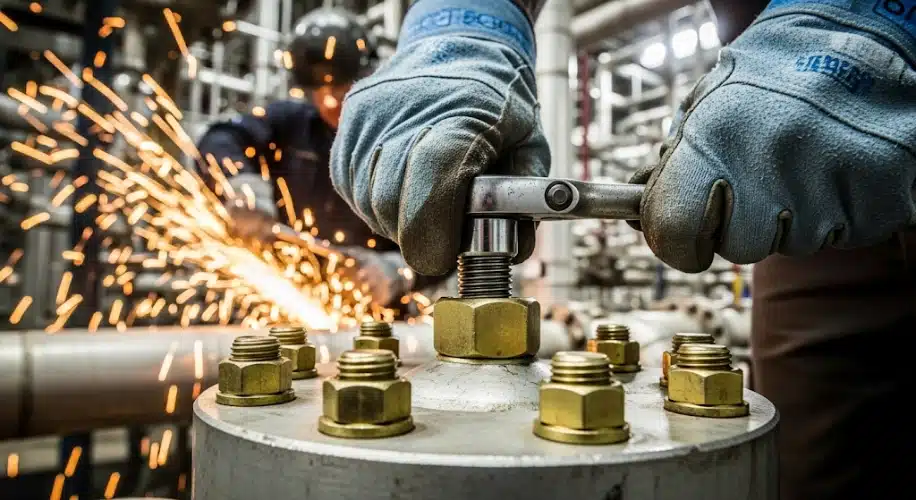
When a fastener fails under pressure, the consequences are immediate and severe. A flange blowout can release flammable hydrocarbons or toxic chemicals at incredible velocity, creating a high risk of fire, explosion, or toxic exposure. Even a slow leak from a failed gasket, caused by improper bolt load, can lead to a hazardous vapor cloud. These events put lives at risk and can cause irreversible environmental damage. Therefore, meeting high-pressure fastener requirements is not just about performance—it’s about prevention of the worst-case scenario. This commitment to prevention is the very essence of world-class petrochemical safety standards.
Beyond the immediate safety risks, fastener failure carries enormous financial and reputational costs. Consider the following:
Consequently, the small upfront cost saving of using a non-certified bolt is insignificant compared to the monumental costs of a potential failure. The most reliable path is to engage a provider of professional industrial bolting solutions Saudi Arabia to guarantee compliance from the start.
Sourcing genuine API-certified fasteners is only half the battle. Proper installation is just as critical.
Navigating the procurement process for critical components requires diligence. For project managers and engineers in the Kingdom, ensuring that your fasteners are genuine and meet all specifications is a crucial responsibility. This process involves more than just placing an order; it requires verification, documentation, and a partnership with a supplier who understands the local landscape.
In Saudi Arabia, major industrial players and regulatory bodies have stringent requirements. Achieving API 20E compliance KSA means ensuring that every fastener used in a critical application is not only manufactured to the API 20E standard but is also accompanied by complete and verifiable documentation. Local inspectors and client auditors will demand to see Material Test Certificates (MTCs) and certificates of conformance. Without this paperwork, your components are considered non-compliant, regardless of their actual quality. This is why working with a supplier who proactively provides this documentation is essential for smooth project execution in the Kingdom. A reliable partner specializing in industrial bolting solutions Saudi Arabia will have these processes streamlined.
You must be proactive in verifying the authenticity of your API-certified fasteners. Here’s how:
Ultimately, diligence during procurement is a core part of upholding your site’s petrochemical safety standards.
| Action | Description |
| ✅ DO: Always demand full Material Test Certificates (MTCs). | This is your primary tool for verifying authenticity and ensuring API 20E compliance KSA. |
| ✅ DO: Partner with a supplier who understands high-pressure fastener requirements. | A specialist supplier will guide you to the correct BSL and material grade for your application. |
| ❌ DON’T: Ever substitute a non-certified fastener in a critical path application. | The risk of failure is too high, and the potential consequences are catastrophic. |
| ❌ DON’T: Overlook the importance of correct installation and torque procedures. | The best API-certified fasteners can fail if they are not installed correctly. |
Choosing the right components is critical, but choosing the right partner is just as important. In a demanding market like Saudi Arabia, you need more than just a supplier; you need a solutions provider who understands the local regulations, the environmental challenges, and the urgency of your operations. AskA Solution is a leading provider of industrial bolting solutions Saudi Arabia, built on a foundation of expertise and responsiveness.
Our team doesn’t just sell parts; we provide solutions. We have extensive experience working with the petrochemical, oil and gas, and power generation sectors across the Kingdom, including in key industrial hubs like Dammam, Riyadh, Khobar, Jubail, and Jeddah. We understand the nuances of API 20E compliance KSA and work with you to ensure your project meets all client and regulatory requirements. Our deep knowledge of high-pressure fastener requirements and petrochemical safety standards makes us a trusted advisor for your most critical applications. We ensure every set of API-certified fasteners we supply is fully documented and ready for deployment.
We recognize that industrial operations don’t stop at 5 PM. An unexpected shutdown or a critical component failure requires immediate action. AskA Solution offers 24/7 emergency support to help you get back online as quickly as possible. Our responsive team can mobilize quickly to supply the necessary API-certified fasteners and support services you need to minimize downtime and secure your facility. This commitment to around-the-clock service is a core part of our mission as a leader in industrial bolting solutions Saudi Arabia.
Feature | AskA Solution | General Suppliers |
| API 20E/20F Technical Expertise | ✅ | ❓ |
| Verifiable Material Traceability | ✅ | ❌ |
| 24/7 Emergency Industrial Support | ✅ | ❌ |
| KSA Petrochemical Experience | ✅ | ❓ |
In conclusion, the integrity of your petrochemical facility is built on the quality of its smallest components. API-certified fasteners are not an optional upgrade; they are an essential foundation for operational safety, regulatory compliance, and long-term reliability. By understanding the differences between BSL levels, demanding complete documentation, and adhering to strict installation protocols, you actively mitigate risk and uphold the highest petrochemical safety standards.
Furthermore, choosing a knowledgeable local partner is crucial. A provider of expert industrial bolting solutions Saudi Arabia like AskA Solution offers more than just parts—we deliver peace of mind. We ensure every component meets the stringent high-pressure fastener requirements of your industry and that you have the support you need to maintain API 20E compliance KSA. In an industry where there is no room for error, make the choice that prioritizes safety and quality every time.
Top 5 Benefits of Full-Threaded API 20E BSL-2 Stud Bolts